
Plant a Piedmont Prairie in your Raleigh, Durham, Cary, or Wake Forest yard and within a season or two you’ll have a rotating cast of at least a dozen bird species stopping by to feed, and some of them will stay to nest, because a native meadow offers exactly what a lawn can’t: standing seed heads, insect-rich thatch, and open ground to forage. Below is what we’ve learned watching these birds move through prairie plantings across the Triangle, what draws each one in, and how a cleared, sun-filled yard, often the direct result of removing a dead or overcrowded tree, gives a prairie the room it needs to thrive.
Why a Prairie Pulls in Birds a Lawn Never Will
A mowed lawn is close to a biological dead zone. It offers almost no seed, very few native insects, and no cover for a bird to land in without feeling exposed. A Piedmont Prairie flips all three of those. According to the Cornell Lab of Ornithology, North America has lost nearly 3 billion breeding birds since 1970, and grassland species have been hit harder than almost any other group. Restoring even a small patch of native meadow habitat directly counters that loss at the yard level, which is part of why we push this planting style so hard with clients who want their landscaping to actually mean something.
The North Carolina Wildlife Resources Commission notes that the Piedmont’s mix of woodlands, open fields, and edge habitat supports both forest-dependent songbirds and open-meadow species, which is exactly the layered structure a well-designed prairie recreates in a residential setting. That combination, structural diversity plus native plant food sources, is what separates a prairie from a wildflower bed that looks nice but doesn’t actually hold birds.
Which Plants Attract Which Birds
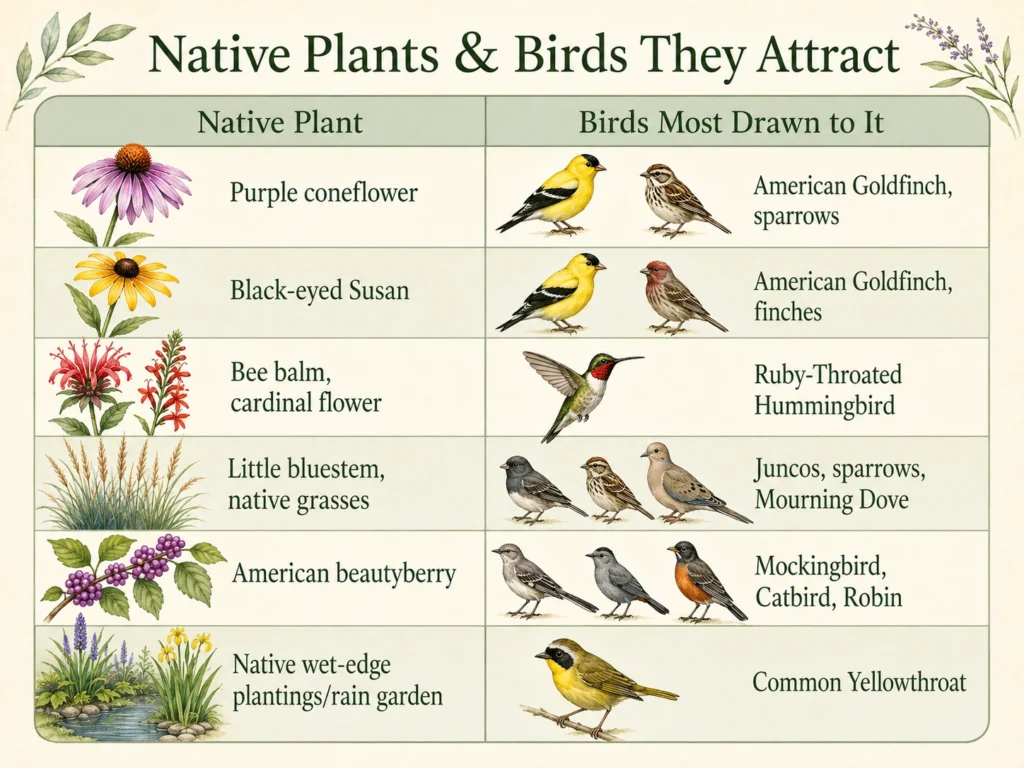
12 Birds You Can Expect in a Piedmont Prairie
1. American Goldfinch (Spinus tristis)
Year-round in North Carolina, goldfinches are strict seed eaters with a real preference for coneflower, black-eyed Susan, and other native composite flowers. They cling to dried seed heads well into winter, which is exactly why we tell clients not to cut a prairie back until late winter, doing it early strips away a food source birds are actively relying on.
2. Dark-Eyed Junco (Junco hyemalis)
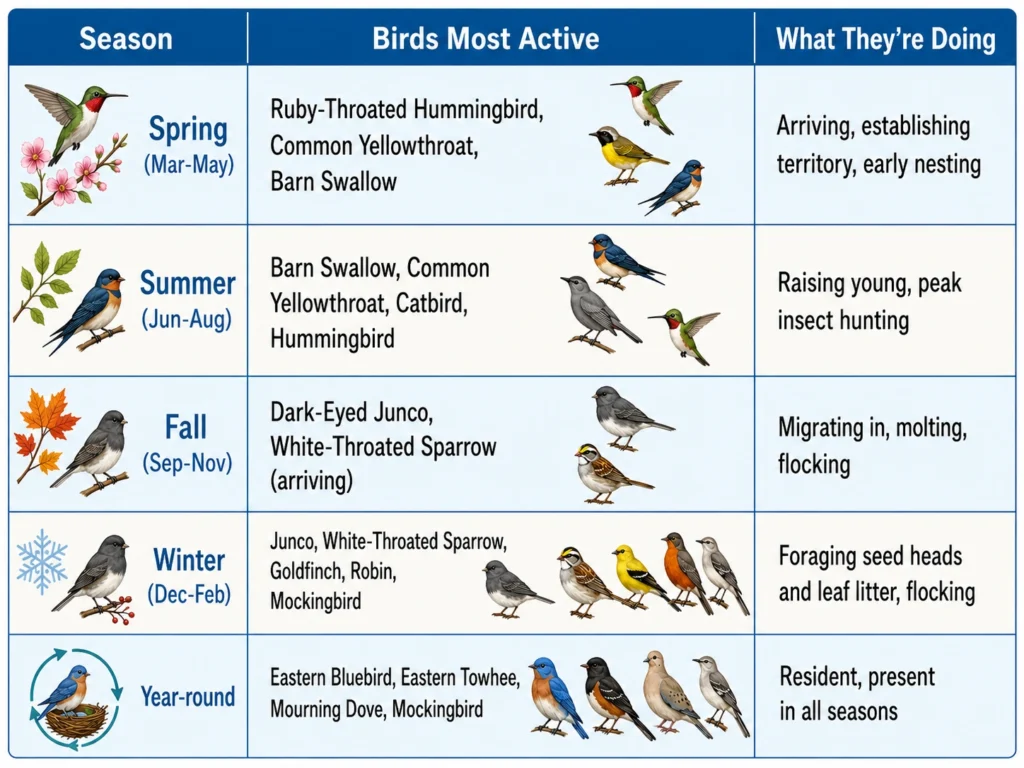
Juncos drop down from mountain and northern breeding grounds each fall and spend the winter foraging through leaf litter and fallen seed at the base of prairie grasses. If you notice a small gray flock scattering ahead of you as you walk the yard in December, that’s almost certainly juncos.
3. White-Throated Sparrow (Zonotrichia albicollis)
Present from October through April, this sparrow forages with a distinctive backward, two-footed hop that kicks up leaf litter and loose thatch. Prairies that are allowed to stay a little messy over winter, rather than raked clean, hold noticeably more of these birds.
4. Eastern Towhee (Pipilo erythrophthalmus)
A year-round resident that’s often heard before it’s seen, scratching loudly through leaf litter at the shrubby edge of a prairie planting. Towhees favor the transition zone where meadow meets thicket, which is one reason we often recommend pairing a prairie with a native hedge or thicket along its border.
5. Eastern Bluebird (Sialia sialis)
Bluebirds are year-round Southeast residents and among the most requested birds by our clients. They hunt from a perch, dropping down onto insects rather than foraging on the ground, so a fence post, shepherd’s hook, or nest box near the prairie edge meaningfully increases how often they stick around.
6. American Robin (Turdus migratorius)
Robins are present in North Carolina all year, not just in spring as most people assume. In winter they shift from earthworms to fruit and berries, often moving through in large, fast-moving flocks. Open foraging ground paired with nearby fruiting shrubs is what keeps them coming back.
7. Common Yellowthroat (Geothlypis trichas)
This warbler, easy to identify by the male’s black mask, nests low in dense meadow vegetation and does best in prairies with some nearby moisture, whether that’s a rain garden, low wet spot, or a consistent birdbath. Its repeated “witchety-witchety-witchety” call is one of the more distinctive prairie sounds in late spring.
8. Barn Swallow (Hirundo rustica)
Swallows don’t forage in the meadow itself, they hunt the airspace above it. A mature summer prairie throws off a heavy insect hatch, and watching swallows work that airspace at dusk is one of the more satisfying payoffs of a well-established planting.
9. Mourning Dove (Zenaida macroura)
A year-round ground forager that methodically works open patches for fallen seed. Prairies with a few bare or thin patches, rather than 100% dense cover, tend to hold more doves, since they need open ground to walk and feed.
10. Northern Mockingbird (Mimus polyglottos)
Territorial, bold, and a talented mimic capable of running through dozens of borrowed songs in one performance. Mockingbirds are opportunistic feeders, shifting between insects and fruit by season, which is another argument for planting a diverse mix rather than a single species.
11. Gray Catbird (Dumetella carolinensis)
Named for its cat-like mewing call, the catbird breeds through summer and favors the dense shrubby margins where a prairie meets a hedge or woodland edge. Like the mockingbird, it’s a mimic, but tends to jumble phrases into a longer, murmuring run rather than distinct repeats.
12. Ruby-Throated Hummingbird (Archilochus colubris)
Present from spring through fall, hummingbirds need nectar-rich flowers for fuel but rely heavily on small insects to raise young. A prairie mix heavy on tubular native blooms, like bee balm or cardinal flower, draws them in reliably and keeps them defending territory around your yard all summer.
What We have Noticed Installing These Across the Triangle
On the properties we’ve planted, the pattern is consistent: goldfinches and sparrows show up almost immediately once seed heads form, usually within the first blooming season. Bluebirds and swallows take a little longer, generally showing up in year two once insect populations in the thatch have had time to build. The biggest jump we see is always after the first full winter left uncut, clients who resist the urge to tidy up in November consistently report more junco and white-throated sparrow activity by January than those who cut the prairie back early.
How to Attract More Birds to an Existing Prairie
- Leave seed heads standing through winter.Cutting back in fall removes a food source several species on this list depend on.
- Add a water source.A birdbath or small rain garden edge draws in species like the Common Yellowthroat that otherwise wouldn’t linger.
- Plant in clusters, not single specimens.Birds locate and use concentrated food sources far more efficiently than scattered individual plants.
- Border the prairie with a native hedge.Species like towhees and catbirds specifically favor the edge where open meadow meets shrubby cover.
- Skip pesticides entirely.A prairie’s bird value depends on the insect population it supports; pesticide use undercuts the whole system.
A Note on Timing
Most seed-eating species, like goldfinches and sparrows, appear within the first year once flowers begin producing seed. Species that need more structural cover or a longer-established insect base, like bluebirds, towhees, and catbirds, typically take two to three years as the planting matures. If you’re not seeing much activity in year one, that’s normal, not a sign the planting failed.
Year-Round Bird Activity Calendar
Removing the Right Tree Can Open Up Space for a Prairie
A lot of the yards where we’ve watched a prairie take off the fastest had one thing in common first: a dead, dying, or overcrowded tree came down to let real sunlight reach the ground. Most prairie species need 6 or more hours of direct sun, and a single overgrown volunteer tree or storm-damaged canopy is often the only thing standing between a shady lawn and a vibrant native meadow. If a hazardous or shade-heavy tree is holding your yard back, scheduling professional tree removal services in Raleigh and the Triangle is often step one toward opening up the sunlight a prairie needs to thrive.
Ready to Get Started?
A Piedmont Prairie isn’t just a lower-maintenance alternative to a lawn, it’s a functioning piece of habitat that a dozen or more bird species will actively use across the year, from the first coneflower bloom through the coldest weeks of winter. The species mix, the willingness to leave things a little wild through the off-season, and a nearby water source all shape exactly which birds show up and how often. In our experience, the yards that commit to leaving the prairie standing through winter are consistently the ones with the most bird activity by spring.
Want to plan a prairie specifically to attract the birds on this list? If a dead or overcrowded tree is blocking the sunlight your prairie would need, we serve Raleigh, Durham, Cary, and the greater Triangle area for tree removal, and we’re happy to walk your property and tell you honestly what needs to come down and what doesn’t.
.