The recent loss of Sherwood Forest’s famous 1,000-year-old Major Oak serves as a stark reminder of how compounding drought and heat stress can impact even the strongest trees. From lessons learned across the Atlantic to North Carolina’s severe ongoing dry spell, taking proactive care of your yard’s soil and root systems is more important than ever. Here is what current drought trends mean for your trees and how you can protect your landscape today.
A Legend Falls: The Major Oak's Death and What It Means
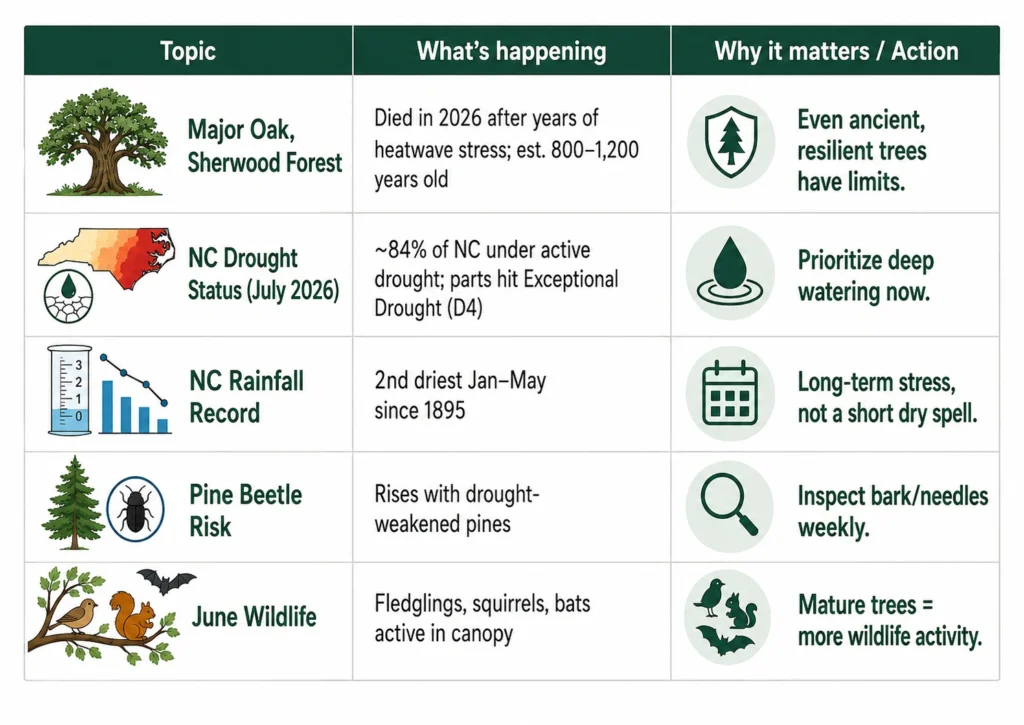
In one of the more sobering tree stories of the year, the Royal Society for the Protection of Birds confirmed in June 2026 that the Major Oak, one of the largest and most famous ancient trees in Western Europe, thought to be between 800 and 1,200 years old, has died after failing to produce leaves this spring. The tree, linked to the Robin Hood legend and located at the heart of Sherwood Forest, had shown visible decline since 2022, producing fewer leaves each year as repeated heatwaves took a cumulative toll. In 2025 alone, the RSPB delivered roughly 660 gallons of water directly to the tree’s roots in an effort to help it survive.
Why this matters beyond one famous tree: RSPB scientists noted that decades of well-intentioned preservation efforts, metal bracing, concrete fill, and coverings, may have inadvertently prevented the tree from aging and adapting naturally, adding stress on top of the heat and drought pressure it was already facing. It’s a striking real-world example of a theme we cover constantly: even a tree with a thousand years of resilience behind it can be pushed past its limit when heat stress and root disturbance compound each other. The knowledge gained from studying the Major Oak’s decline is now informing how conservationists protect the nearly 1,000 other ancient oaks still standing in Sherwood Forest.
The North Carolina Drought Update: Where Things Stand Right Now
Closer to home, the picture remains serious. As of late July 2026, roughly 84% of North Carolina is under active drought classification, with severe and extreme drought covering the majority of that footprint. Earlier this year, north-central North Carolina reached Exceptional Drought (D4) status for the first time since March 2008, before a wetter pattern in May brought some relief and the exceptional classification was later removed in parts of the state. Even so, June rainfall has again come in below normal across much of the Piedmont and Carolinas, meaning many of the trees that looked fine in May are starting to show real stress heading into summer.
What this means for your yard right now:
- Prioritize deep watering for young trees and anything planted in the last three years
- Hold off on fertilizing, which pushes growth a stressed tree can’t currently support
- Watch pines especially closely; drought-weakened pines are vulnerable to bark beetle infestation, visible as peeling bark and bright brown (not gradually yellowing) needles
Backyard Acrobats: June Wildlife Watch
June brings a burst of activity in the canopy as young wildlife starts exploring the world. Keep an eye out for:
- Fledgling birds making clumsy first flights between branches
- Squirrels chasing each other along limbs in territory and mating displays
- Bats becoming more visible at dusk as insect activity peaks with the warmer weather
A yard with mature trees and layered native plantings supports far more of this activity than a lawn-only landscape, since birds and small mammals rely on that vertical structure for nesting, food, and cover, something a stressed, drought-thinned canopy provides less of every year the dry pattern continues.
June 2026 at a Glance
A Reader Question
“My oak’s leaves are curling but not falling. Is this drought stress or disease?”
Leaf curl without leaf drop is a very common early drought response; it’s the tree reducing its leaf surface area to cut down on water loss, not necessarily a sign of disease. Continue deep watering and monitor closely. If curling is paired with spotting, discoloration, or actual leaf drop, it’s worth a professional look, especially given how widespread drought stress is across the region this season.
Final Thoughts
Between a thousand-year-old oak finally succumbing to cumulative heat stress an ocean away and a drought that’s stretched into its second consecutive dry spring here at home, this month is a good reminder that even the toughest, most established trees have limits. Consistent deep watering and protecting the soil that supports everything else remain the most effective things any of us can do right now.
Worried about how your trees are handling this drought? Reach out for a free health check and a watering plan built specifically for your yard.