If you own a second home in Raleigh, Durham, Cary, or anywhere in the Triangle and are not on the property full-time, the trees around it are the single biggest storm liability you are not watching closely enough, and this checklist tells you exactly what to inspect, when to schedule it, and how to manage tree risk from a distance. Absentee ownership does not cause tree failure by itself, but it does mean warning signs that a full-time resident would catch in passing, a new lean, a cracked limb, a patch of fungus at the base, can sit undetected for months until a storm turns them into a claim.
Why Second Homes Carry Higher Tree Risk
For a full-time resident, a leaning tree or a dead limb over the driveway gets noticed on the way to the mailbox. For a second homeowner who visits monthly, seasonally, or only a few times a year, that same defect can develop for months without anyone seeing it right up until a storm turns a slow-building problem into an insurance claim, a damaged roof, or worse. Check out our guide on 6 warning signs to look for before storm season to evaluate your trees before the weather turns.
What Makes a Tree an Actual Storm Risk
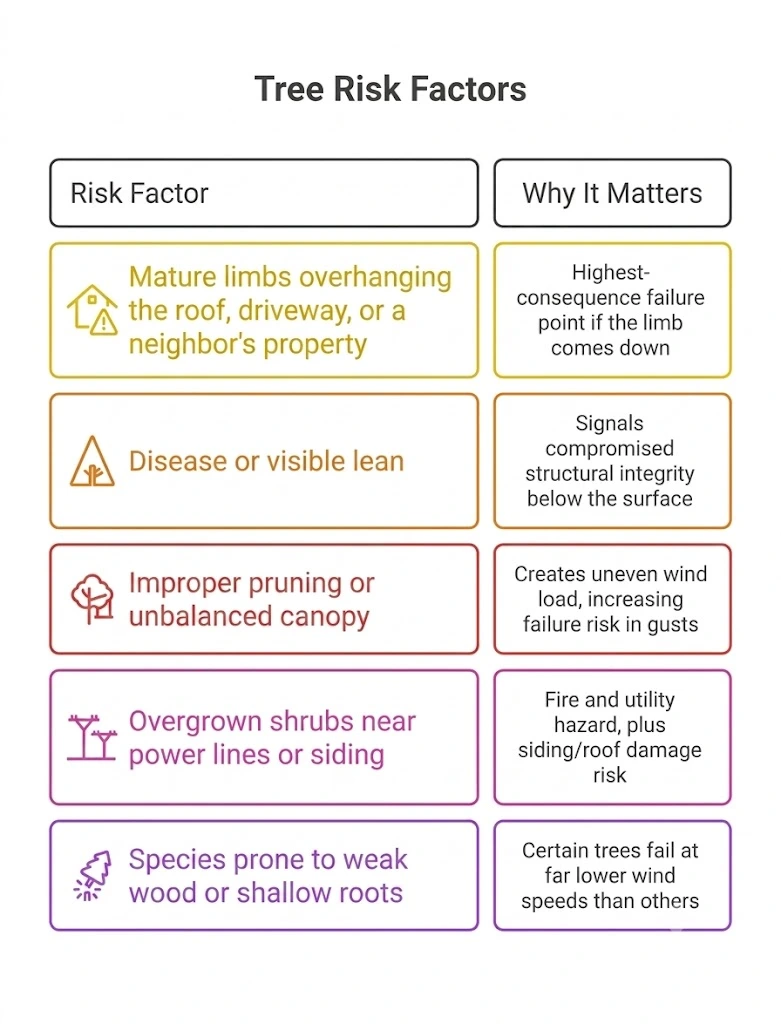
The International Society of Arboriculture recommends a structured Tree Risk Assessment, evaluating the likelihood of failure, what it could hit, and how severe the consequences would be, rather than relying on a quick visual guess. That structured approach matters even more for a property nobody is walking past daily.
Spring and Fall: The Two Windows That Matter Most
For a second home, timing tree care around the calendar, not around when you happen to visit, is what actually prevents storm damage.
Spring (before hurricane season ramps up):
- Full canopy inspection and structural pruning
- Remove any deadwood that survived winter
- Check for early pest or disease activity before it spreads through summer
Fall (before winter storms and the absentee months that follow):
- Remove deadwood accumulated over the growing season
- Schedule cabling or bracing inspections on any previously flagged trees
- Root collar and root inspection before ground freezes limit access
Scheduling both visits in advance, rather than waiting until you happen to be on-site, is the single most effective habit we see among second homeowners who never end up dealing with storm
Why an Ongoing Plant Health Care Program Matters More for Absentee Owners
Tree problems rarely appear overnight. They build slowly, and slow-building problems are exactly what absentee ownership misses. A structured Plant Health Care (PHC) program, managed by a certified arborist on a set schedule rather than an as-needed basis, closes that gap.
- Prescription pruningreduces storm-related breakage by correcting structural weaknesses before wind exploits them
- Soil care and fertilizationbuild root resilience ahead of heat stress or storm season
- Pest and disease monitoringcatches infestations early, before they spread through an unattended canopy
- Mulching and watering planskeep trees healthier through drought and heavy rain extremes alike
- Root collar inspectionscatch girdling roots or a buried root flare, defects that quietly undermine a tree’s stability for years before it’s visible above ground
A managed PHC plan effectively puts a set of professional eyes on your property on a schedule, whether or not you’re there to walk it yourself.
Proactive Storm Checklist While You Are Away
- Schedule late-season pruningbefore peak wind or hurricane season arrives, not after a storm warning is already posted
- Mulch properlyto protect root zones from both intense summer heat and heavy rainfall
- Install smart irrigation timersto maintain consistent root hydration through long absences
- Inspect cables, braces, and any existing support systems for wear, since a failed cable can turn a stabilized tree back into a liability
- Avoid planting risky specieslike shallow-rooted pines or fast-growing, weak-wood ornamentals close to the house or driveway
Local Storm History Worth Knowing
North Carolina has been directly affected by tropical systems reaching well into the Piedmont in recent years, including Hurricane Florence in 2018 and Hurricane Helene’s remnant flooding in 2024, both of which brought down trees and limbs far from the coast. The Piedmont’s clay-heavy soil also tends to stay saturated longer after heavy rain than sandy coastal soil, which keeps root systems vulnerable to wind-throw for days after a storm technically passes, not just during the event itself.
Species to Watch (and Rethink) on a Second Home Property
Some commonly planted species carry disproportionate storm risk due to weak wood, shallow roots, or narrow branch angles. If any of these are already established near your home, they’re worth flagging for a closer inspection rather than automatic removal:
- Bradford pear– narrow crotch angles and included bark make it prone to splitting apart in wind
- Silver maple– fast growth comes with notably weak, brittle wood
- Loblolly and other shallow-rooted pines– can uproot in saturated soil during heavy, prolonged rain
- Water oak– prone to interior decay that isn’t visible from the outside until failure
What Remote Property Owners Can Do Between Visits
Since you cannot walk the property every week, a few systems close most of the gap:
- Set a standing inspection schedule. Book spring and fall visits in advance so risk assessment is not dependent on your travel calendar.
- Ask for photo or video documentation.A property report with images gives you a real record to compare season to season, not just a verbal “it is fine.”
- Authorize a point of contact. A neighbor, property manager, or caretaker who can call in a professional immediately after a storm, rather than waiting for your next visit, meaningfully limits damage.
- Keep contact details ready for emergency tree removal in Raleigh long before storm season starts. When an active warning hits, every local crew is booked solid, so having a trusted service on file ahead of time saves critical hours.
Do Not Wait Until the Next Storm Hits
A second home in the Raleigh or Triangle area does not have to be a storm liability just because you’re not there full-time. The risk is not distance itself, it is the gap between when a problem starts and when someone notices it. Scheduled spring and fall inspections, a managed plant health care plan, and a standing relationship with a local tree service close that gap almost entirely, so the first time you hear about a tree problem is not in a claims adjuster’s phone call.
Own a second home in Raleigh, Durham, Cary, or the surrounding Triangle and want a standing inspection schedule set up before this season’s storms arrive? Reach out and we will build a spring and fall plan around your property, whether you are in town for it or not.