The single most effective thing you can do for a tree in drought is water deeply and infrequently rather than a quick daily sprinkle, and that principle matters more than ever right now. As of late July 2026, roughly 84% of North Carolina remains under active drought conditions, according to the U.S. Drought Monitor, with nearly a quarter of the state classified as Extreme Drought. This isn’t a distant, hypothetical concern. It’s the reality trees across the region are dealing with right now, and the seven habits below are built around what actually helps.
Understanding the Scale of This Drought
North Carolina experienced its second driest January-through-May stretch on record since 1895, according to Drought.gov’s June 2026 regional update. Parts of north-central North Carolina reached Exceptional Drought (D4) status this year, a classification that hadn’t occurred in that part of the state since March 2008. NC State Extension Forestry notes that while established trees over a year old typically withstand moderate to severe drought on their own, the combination of drought with other stressors, pests, disease, or construction damage, is where real tree loss happens.
Water Deeply, Not Frequently
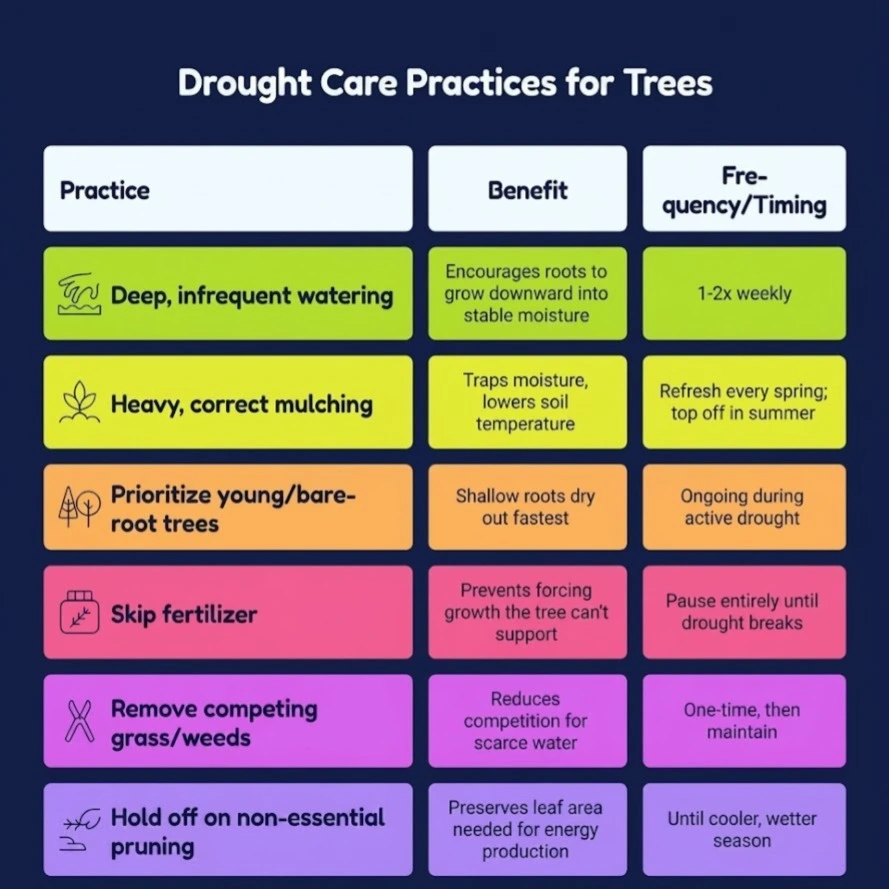
Shallow, frequent watering trains roots to stay near the surface, where soil dries out fastest. Deep, infrequent watering pushes roots downward into cooler, more stable soil moisture that holds up better between rain events.
How to do it right: Let a hose trickle slowly at the tree’s drip line (the edge of the canopy, not against the trunk) for 30 to 45 minutes, once or twice weekly during active drought.
Mulch Heavily and Correctly
NC Cooperative Extension specifically recommends heavy mulching around the base of young trees during drought to lower soil temperature and trap scarce moisture. A 2 to 3 inch layer spread to the drip line, kept a few inches back from the trunk, makes a measurable difference in how long soil stays moist between waterings.
Prioritize Newly Planted and Bare-Root Trees First
Extension forestry data is consistent on this point: young, newly planted trees, especially bare-root seedlings, are the most vulnerable during drought because they lack the deep, fine root systems needed to find scarce soil moisture. This risk multiplies in compacted soil, such as old lawns or former agricultural land, which restricts how deep those young roots can reach in the first place.
Priority order when water is limited:
- Trees planted within the last 1 to 3 years
- Mature, high-value shade or specimen trees
- Established native shrubs
- Lawn areas (grass typically recovers even after going dormant)
Skip Fertilizer During Active Drought
Fertilizing a stressed tree during drought pushes it to produce new growth it doesn’t have the water to support, adding stress rather than relieving it. Wait until soil moisture recovers before feeding any tree or shrub showing drought symptoms.
Eliminate Competing Vegetation Near Young Trees
Grass and weeds growing right up to a young tree’s trunk compete aggressively for the same limited water. Removing turf in a ring around the base, and replacing it with mulch, means more of every gallon you apply actually reaches the tree’s roots instead of the surrounding lawn. showing drought symptoms.
Hold Off on Non-Essential Pruning
Leaves are what a drought-stressed tree relies on to keep producing energy. Unless a branch is dead, damaged, or genuinely hazardous, save shaping and thinning cuts for a cooler, wetter season when the tree has the resources to recover from the wounds.
Watch for Delayed, Secondary Drought Damage
This is the piece most homeowners miss. Drought rarely kills a mature, established tree outright. The real danger is what it enables afterward. In heavily forested areas, prolonged moisture deficit has been directly linked to outbreaks of southern pine beetle and other bark beetles, which target trees already weakened by water stress. NC Cooperative Extension specifically advises watching for pine trees with peeling bark and unusually bright brown (rather than gradually yellowing) needles, a sign of active beetle infestation that often requires immediate removal.
Signs a Tree Is Already in Drought Stress
- Leaves that curl, wilt, or scorch at the edges
- Early or unusual leaf drop, especially mid-summer
- Pine needles that yellow or brown and drop prematurely
- Bark that looks unusually dry, cracked, or is peeling in patches
Recovering After the Drought Breaks
When rain finally returns, don’t assume the tree is immediately in the clear. Continue monitoring through the following growing season. Drought-weakened trees remain more vulnerable to pests and disease for months, sometimes years, after soil moisture recovers, which is exactly the window where secondary problems like beetle infestations tend to show up.
Final Thoughts
With the majority of North Carolina still classified under active drought as of this writing, the trees on your property are almost certainly dealing with real water stress right now, whether or not it’s visibly obvious yet. Deep watering, smart mulching, and knowing which trees to prioritize can be the difference between a tree that bounces back this fall and one that doesn’t survive to see it.
Not sure which of your trees need water most urgently? Reach out for a drought stress assessment and a watering plan built around your specific property.