A tree that looks perfectly healthy from your porch can still fail catastrophically in a storm, and certified arborists know this because tree failure is almost never random. It’s the result of a structural weakness that was already there long before the wind picked up. High winds don’t create these problems, they expose them. Below are the six warning signs professionals actually check for during a pre-storm risk assessment, and what to do about each one.
Why This Matters More Than Most Homeowners Realize
Tree work is one of the most dangerous professions in the country. According to the Bureau of Labor Statistics’ February 2026 report, 228 landscaping workers were killed on the job nationally in 2023, and industry data puts the tree care fatality rate at roughly 11 times the all-industry average. That statistic isn’t meant to scare you away from inspecting your own trees from the ground, it’s meant to underline why professionals take structured risk assessment so seriously, and why DIY removal of a compromised tree is rarely worth the risk.
Certified arborists typically follow the ISA’s Tree Risk Assessment Qualification (TRAQ) methodology, guided by ANSI A300 standards. This structured approach evaluates three things together: the likelihood a part of the tree will fail, the likelihood it hits something (or someone), and how severe the consequences would be. The result is a lot more reliable than eyeballing a tree and guessing.
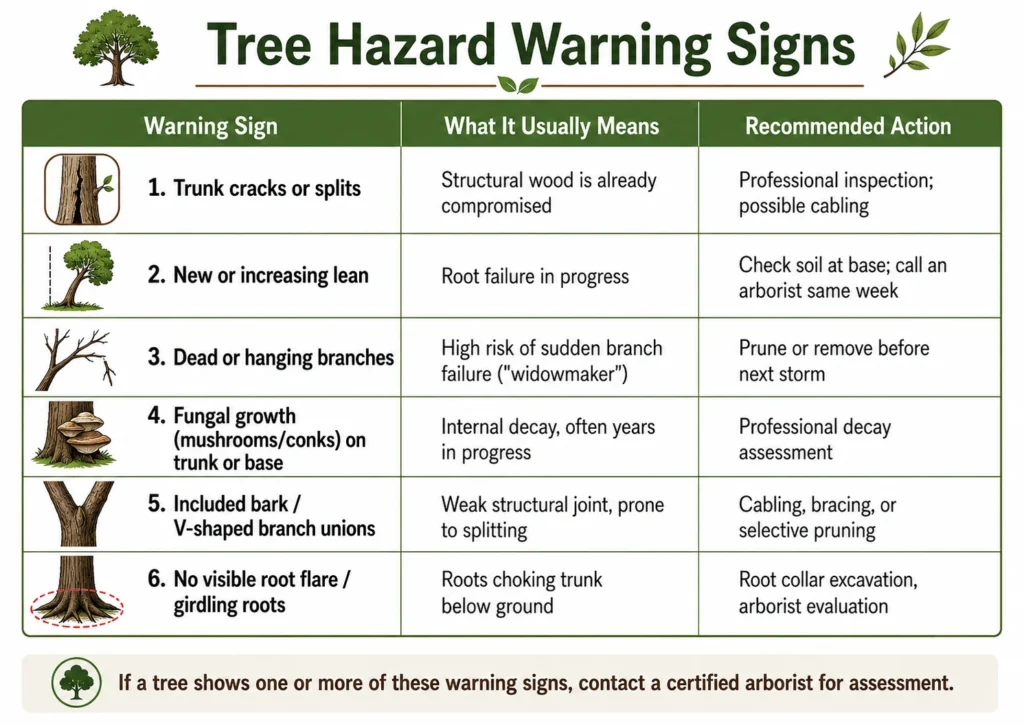
Warning Signs At a Glance
Cracks or Splits in the Trunk
Trunk failure is one of three major categories of tree failure recognized by extension forestry programs, alongside branch failure and root failure. A vertical crack running any real distance up the trunk, especially one you can see daylight through, signals that the tree’s structural wood is already compromised.
What to check: Walk the full circumference of the trunk, not just the side facing your house. Cracks frequently develop on the side you never look at, especially the side facing prevailing winds.
A New or Increasing Lean
A tree that has leaned its entire life in the same gentle direction is often stable; a new lean, or one that’s visibly increasing, is a different story. Ground heaving on one side of the trunk base is one of the clearest visual signs of developing root failure, and it’s one of the first things arborists are trained to look for during a walking inspection.
Quick test: After a heavy rain, check the soil directly around the base. Cracked, lifted, or heaved soil on one side is a strong indicator that roots are pulling loose.
Dead or Falling Branches (The "Widowmakers")
Branch failure is the single most common type of tree failure, and it’s also the easiest to prevent, because it’s often visible from the ground with a simple upward glance. Large dead branches caught in the canopy, sometimes called widowmakers, can come down in a moderate storm with no warning at all.
Signs a branch is dead rather than just dormant:
- No leaf buds in spring while neighboring branches have fully leafed out
- Bark that’s peeling, cracked, or missing in patches
- A branch that snaps dry and clean rather than bending
Fungal Growth at the Base or on the Trunk
Mushrooms or shelf-like conks growing directly from bark or exposed roots usually indicate internal decay that’s already been progressing for years by the time it becomes visible on the outside. This is exactly why a tree can look green and full one week and split apart in a storm the next: the canopy can stay healthy even while the structural wood underneath is hollowing out.
Included Bark and Weak Branch Unions
When two large limbs grow too close together, bark can become trapped between them instead of forming a solid, fused connection, a defect called included bark. This creates a permanently weak joint that’s especially prone to splitting under wind load. It’s such a common, predictable failure point that entire tree species are flagged for it: Bradford pears, for example, are notorious for narrow crotch angles and included bark, and most arborists consider their eventual splitting apart a matter of “when,” not “if.”
How to spot it: V-shaped branch unions are structurally weaker than U-shaped ones. Look for any spot where a major limb seems only loosely, pinched, or unevenly attached to the trunk.
Girdling Roots and Compromised Root Flare
A tree’s root flare, the point where the trunk widens out into the ground, should be visible at the soil surface. A trunk that goes straight into the ground like a utility pole, with no visible flare, often signals girdling roots circling and choking the trunk below ground, a defect that slowly undermines the tree’s stability over years.
Quick Pre-Storm Checklist
- Walk the full circumference of every large tree’s trunk
- Look up into the canopy for dead, hanging, or broken branches
- Check the base for fungus, cracked soil, or an unclear root flare
- Note any branch unions that look tightly pinched or V-shaped
- Identify any Bradford pear, silver maple, or other structurally weak species on your property
- Photograph anything questionable and get a professional opinion before the next storm
Species Worth Extra Scrutiny
Not all trees carry the same structural risk. Species known for weak wood, narrow branch angles, or high susceptibility to storm damage deserve closer inspection every season, including Bradford pear (included bark, narrow crotch angles) and silver maple (brittle wood, prone to ice and wind damage). Ash trees weakened internally by emerald ash borer are a special concern, since they can look structurally fine from the outside while being hollow inside.
When to Call a Professional Instead of Handling It Yourself
Not all trees carry the same structural risk. Species known for weak wood, narrow branch angles, or high susceptibility to storm damage deserve closer inspection every season, including Bradford pear (included bark, narrow crotch angles) and silver maple (brittle wood, prone to ice and wind damage). Ash trees weakened internally by emerald ash borer are a special concern, since they can look structurally fine from the outside while being hollow inside.
Final Thoughts
Storm damage almost never comes out of nowhere. It comes from a structural weakness that was visible, if you knew where to look, well before the wind arrived. Spending one afternoon walking your property with this checklist can be the difference between a calm storm night and an emergency call at 2 a.m.
Want a professional set of eyes on your trees before the next storm rolls through? Schedule a pre-storm risk assessment and get a clear, prioritized plan before the wind picks up.