Two trees can sit fifty feet apart, experience the exact same rainfall, and come through a drought completely differently, and the reason almost always traces back to what’s happening below the surface. As of mid-2026, North Carolina Cooperative Extension reports that over 90% of the state is experiencing short or very short topsoil moisture, with the top layer of soil in many areas reduced to a dust-like consistency. But even within that shared crisis, soil condition determines which trees make it through and which don’t.
Healthy Soil Acts Like a Sponge
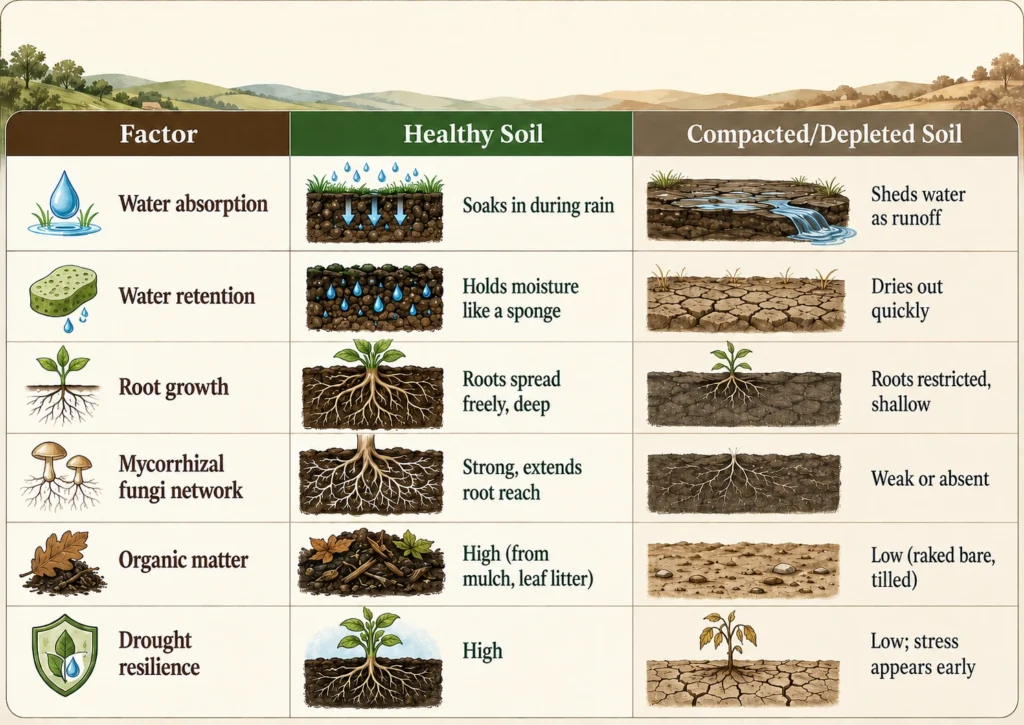
Soil rich in organic matter and free of compaction holds onto water and releases it slowly to roots over time, functioning almost like a reservoir. Compacted or depleted soil sheds water quickly through runoff and dries out fast, leaving little reserve for roots to draw on once rain stops.
The Role of Soil Compaction
Foot traffic, construction equipment, and years of repeated mowing compact soil, squeezing out the pore spaces that would normally hold air and water. Compacted soil:
- Drains poorly during rain, so less water soaks in to begin with
- Restricts how far roots can physically spread in search of moisture
- Makes it harder for young roots to expand into new soil at all
Simple test: Push a screwdriver into the soil near your tree. If it takes real effort to get more than a couple inches deep, the soil is likely compacted enough to be working against your tree during dry periods.
Compacted Soil Multiplies Drought Risk for Young Trees
NC Cooperative Extension has specifically flagged compacted soil, particularly old agricultural fields and former lawns, as a major risk multiplier for young trees during the current drought. Bare-root seedlings planted into this kind of soil are especially vulnerable because their limited root systems simply can’t push deep enough to reach whatever moisture remains.
Organic Matter Is the Real Water Reservoir
Decomposed leaves, roots, and biological material built up in soil over years hold many times their weight in water. Landscapes raked bare every fall, with leaves bagged and hauled away rather than left to break down, slowly lose this reservoir, which is part of why an older, “tidy” yard sometimes struggles more in drought than a slightly wilder one next door.
The Hidden Role of Soil Microbes and Fungi
Mycorrhizal fungi form a symbiotic partnership with tree roots, extending the root system’s effective reach into the soil in exchange for sugars from the tree. Trees with a strong, established mycorrhizal network can access water and nutrients from a much larger volume of soil than their own root hairs could reach alone. Soil that’s been heavily tilled, over-treated with synthetic fertilizer, or stripped of organic matter typically has a weaker fungal network, leaving trees more dependent on whatever moisture happens to sit immediately around their own roots.
Healthy Soil vs. Compacted Soil
The Urban Soil Problem
Urban and residential trees face a specific combination that intensifies drought stress well beyond what’s found in an open forest: soil compaction, stormwater runoff that carries moisture away from root zones instead of into them, and road salt buildup in areas with winter treatment. Extension forestry experts point to this combination, not just low rainfall on its own, as the reason urban trees often show drought symptoms earlier and more severely than trees in undisturbed natural settings just a few miles away.
Why "Right Tree, Right Place" Still Isn't Enough
Even a naturally drought-tolerant, native species can struggle if it’s planted into poor, compacted soil. Soil condition frequently matters more than species selection alone, which is exactly why two identical species planted in different corners of the same yard can show completely different levels of drought stress by midsummer.
How to Improve Soil Before the Next Drought
- Add organic mulch annually around the drip line to slowly rebuild organic matter as it breaks down
- Aerate compacted areas, especially high-traffic zones near tree roots
- Avoid synthetic fertilizers that can disrupt beneficial soil fungi and bacteria
- Leave leaves in garden beds where possible; decomposing leaf litter feeds the same soil food web that helps trees pull in water
- Get a professional soil evaluation to understand compaction depth and organic matter levels specific to your property
Signs Your Soil May Be Working Against Your Trees
- Water pools on the surface during rain instead of soaking in
- Grass struggles to establish under and around the tree
- The ground feels noticeably harder underfoot than other parts of the yard
- Trees in this specific area show drought stress earlier than trees elsewhere on the property
Final Thoughts
Drought stress isn’t only a function of how little rain falls. It’s a function of how much of that rain your soil can actually capture, hold, and deliver to roots. With most of North Carolina still reporting critically low topsoil moisture, investing in soil health through mulching, decompaction, and reduced chemical use builds a buffer that helps trees ride out dry periods far better than soil left to compact and deplete year after year.
Curious what condition your soil is really in? Ask about a soil health evaluation and find out what’s happening beneath the surface before the next dry stretch hits.