A native privacy hedge gives your Raleigh, Durham, or Cary yard complete privacy just like a row of arborvitae but for a lot less money. These local plants handle North Carolina’s tough clay soil and hot, humid summers much better, and they bring natural wildlife to your yard instead of looking like a fake wall of green plastic. In this guide, you’ll learn which local plants grow best in our soil, what they cost, how to plant them, and why so many arborvitae hedges across Wake County are secretly dying out
The Arborvitae Problem Nobody Talks About
Walk down almost any suburban street and you’ll spot the same hedge: a straight line of “Green Giant” or “Emerald Green” arborvitae, usually with at least one dead, browning gap staring back at the neighbors. That gap isn’t bad luck. It’s a predictable outcome of planting a single species in a row.
Arborvitae is genetically identical clone to clone when purchased from most nurseries, which means every plant in the row shares the exact same vulnerabilities. According to Clemson Cooperative Extension, arborvitae is frequently affected by bagworms, spider mites, and canker diseases that can spread down an entire hedge row once established, because there’s no genetic variation to stop it. Add in shallow root systems that struggle in compacted soil and heavy drought sensitivity, and you get a hedge that looks great for year one, then starts thinning by year five.
What a Native Privacy Hedge Actually Is
A native privacy hedge, or thicket, is a dense planting of multiple native shrub and small tree species installed as young saplings rather than one uniform species bought as mature container plants. Instead of a monoculture wall, you get a diverse, layered screen that behaves more like the natural edge habitat found where a forest meets a field.
This isn’t a new idea. It’s simply how privacy screening worked in nature long before “Green Giant” arborvitae became a landscaping default. The difference is structural: a thicket has root systems that interlock and share nutrients, multiple bloom and berry cycles throughout the year, and enough species diversity that a single pest or disease outbreak can’t wipe out the whole screen.
Why Saplings Beat Container Plants
Most privacy hedges are planted using large, expensive container-grown plants that already look mature at installation. It feels like instant gratification, but it comes with hidden costs.
Cost: A 6-foot container arborvitae typically runs $80 to $150 per plant at retail nurseries. Native bare-root or small container saplings, by comparison, often cost between $3 and $15 each depending on species and supplier. For a hedge running 60 feet, that’s a difference that can run into the thousands of dollars.
Root structure: Container plants spend months or years with their roots circling the inside of a pot. Once planted, those circling roots often continue growing in the same spiral pattern instead of spreading outward, a defect called girdling roots that can slowly strangle the plant years later. Saplings, especially bare-root ones, never develop this problem because their roots have never been confined.
Establishment speed: Because sapling roots aren’t fighting years of pot-bound growth habits, they frequently catch up to and surpass container-grown plants in overall size within just a few growing seasons.
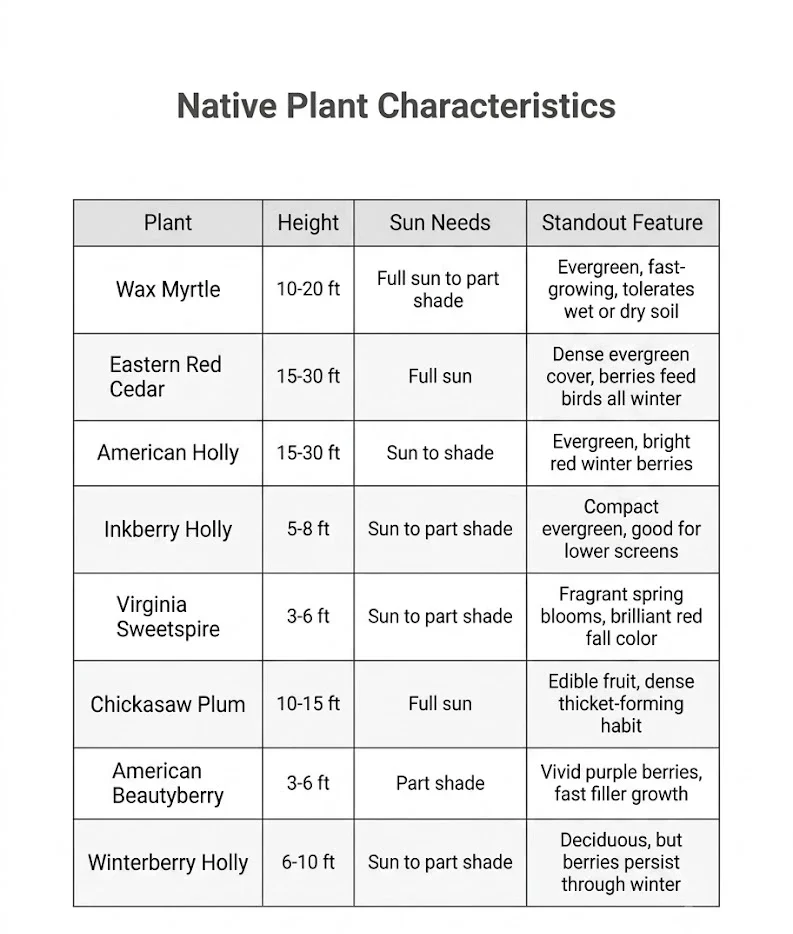
The Best Native Plants for a Privacy Hedge
The right species mix depends on your region, soil, and sun exposure, but these native shrubs and small trees are widely available and proven performers across much of the eastern and southeastern United States.
The Wildlife Case: This Is Not a Minor Detail
A privacy hedge is one of the largest single plantings most homeowners ever install, which means the species choice has a real ecological footprint, for better or worse.
North America has lost nearly 3 billion breeding birds since 1970, roughly 29% of the total bird population, according to a landmark 2019 study published in Science and summarized by the Cornell Lab of Ornithology. Habitat loss is the single largest driver of that decline. A hedge made of non-native arborvitae offers birds almost nothing: minimal insect life, no berries most species can eat, and dense foliage that provides cover but little food.
Entomologist Doug Tallamy’s research, highlighted through his Homegrown National Park initiative, has repeatedly shown that native plants host dramatically more caterpillar and insect biomass than non-native ornamentals, and that insect biomass is exactly what nesting songbirds rely on to feed their young. A single clutch of chickadees, for example, can require thousands of caterpillars before fledging. A hedge with zero native food value effectively becomes a dead zone for breeding birds, no matter how green and full it looks.
For homeowners who want their landscaping choices to matter beyond their own yard, this is the difference: an arborvitae hedge is a wall. A native thicket is a corridor.
How to Plant a Native Privacy Hedge
- Measure and plan your line.Decide on the length and width of your screen. A minimum width of 8 to 10 feet gives plants enough room to fill in densely without looking sparse from either side.
- Choose your species mix.Aim for at least three to eight species so no single pest, disease, or weather event can take out the entire hedge at once.
- Space saplings closely.Unlike traditional landscaping spacing, thickets are planted tightly, often 2 to 4 feet apart, to encourage the dense, interlocking growth that creates fast privacy.
- Plant properly.Dig a hole no deeper than the root ball and roughly twice as wide. Avoid piling soil or mulch against the stem, a mistake known as a mulch volcano that traps moisture against the bark and invites rot.
- Water consistently for the first year.After the first growing season, most native species need little to no supplemental watering beyond normal rainfall.
- Protect young saplings.A simple wire cage or tree tube protects saplings from deer, rabbits, and lawn equipment while they establish.
- Weed during establishment.For the first two to three growing seasons, keep competing weeds and invasive vines pulled back so saplings aren’t fighting for light and water.
When to Plant
Fall and late winter, while plants are dormant, are generally the best windows for installing bare-root or young saplings across most of the country, since this gives root systems time to establish before the stress of summer heat arrives. Always check your USDA Plant Hardiness Zone to confirm which species are reliably winter-hardy in your specific location before finalizing your plant list.
Common Mistakes to Avoid
- Planting only one or two species.This recreates the exact monoculture vulnerability that dooms arborvitae hedges in the first place.
- Spacing plants too far apart.Wide spacing delays the interlocking growth that gives thickets their fast, low-maintenance privacy.
- Skipping soil prep.Compacted soil left over from construction or old turf grass restricts root spread; loosening the planting area first makes a measurable difference in establishment speed.
- Over-mulching against stems.Keep mulch a few inches back from every trunk and stem to prevent rot.
- Choosing species outside your zone.A plant that struggles with your winter lows or summer humidity will never perform the way it does in demonstration photos from a different region.
When an Old Tree Needs to Come Down First
Many of the hedge projects we install in Raleigh, Durham, and Cary start with a removal, not a planting. A declining tree that is shading out one side of the yard, or a hazardous limb overhanging the property line, often has to come down before there is enough sun for a native hedge to establish properly. If you are planning a privacy hedge, exploring our tree removal services in Raleigh, Durham, and Cary is a smart first step to figure out whether an existing tree is helping or hurting your plan before you buy a single sapling.
Conclusion
A privacy hedge is a decades-long commitment, and the arborvitae default most nurseries push is not built to last that long. A native privacy hedge costs less upfront, survives pests and drought better, and turns a purely cosmetic barrier into a functioning piece of habitat that feeds birds and pollinators for the life of your yard. The upfront planning takes a little more thought than grabbing thirty identical plants off a nursery lot, but the payoff, in cost savings, resilience, and ecological value, is substantial.
Ready to replace a struggling arborvitae line or start a new privacy hedge from scratch? We serve Raleigh, Durham, Cary, and the greater Triangle, and if a tree is blocking the sun your new hedge would need, we can handle the removal and help you plan what goes in after. Get a quote now